
In 2026, artificial intelligence is no longer a futuristic concept for marketers; it's the core engine driving growth, efficiency, and creativity. From generating entire campaigns in minutes to personalising customer journeys at scale, AI has become an indispensable part of the modern marketer's toolkit. The challenge is no longer if you should adopt AI, but which tools will deliver the most significant impact.
With hundreds of platforms flooding the market, distinguishing the game-changers from the gimmicks is a critical task. This guide cuts through the noise. We have meticulously analysed and categorised the best AI tools for marketing, providing an in-depth look at their real-world applications, unique strengths, and honest limitations. This resource is designed to help you find the right technology to automate routine tasks, unlock new creative potential, and achieve measurable results.
Whether you are a social media manager, graphic designer, or part of a larger advertising team, this list will guide you to the perfect solution. To understand the breadth of capabilities that AI brings to the table, consider how automated video editing software AI tools for marketing are transforming content creation from a lengthy process into an instant one.
Each recommendation includes key features, ideal use cases, pros, cons, and direct links to help you make an informed decision quickly. Let's explore the tools that will define marketing success this year and beyond.
1. Glima AI
Glima AI establishes itself as a powerful, all-in-one creative suite, making it one of the best AI tools for marketing teams looking to consolidate their workflow. It moves beyond single-function generators by integrating high-calibre image and video creation with a robust set of no-code editing tools, effectively replacing multiple subscriptions with a single, intuitive platform.
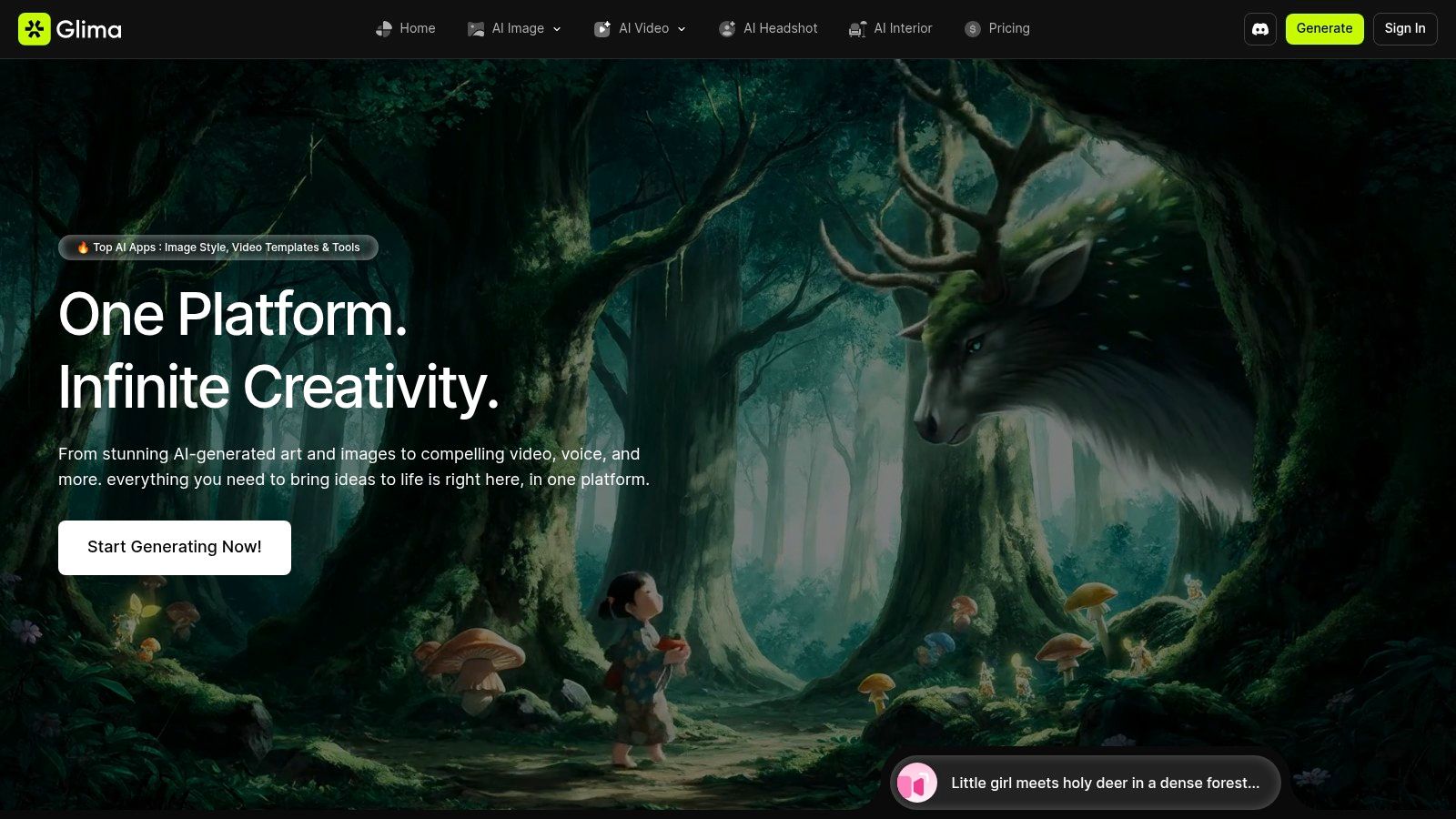
The platform is engineered for both speed and creative breadth. Marketers can rapidly prototype campaign visuals, from product photoshoots to cinematic video clips, using a library of over 100 distinct styles and specialised workflows. This versatility allows teams to produce a wide array of on-brand assets without deep technical expertise. The user experience is consistently praised for making advanced capabilities accessible to beginners while still offering powerful models like "Sora" for pro-level outputs.
Key Features & Use Cases
- Unified Creative Engine: Combines text-to-image, text-to-video, and multi-reference animation in one place. Ideal for creating cohesive campaign assets from social media posts to full-scale video ads.
- Specialised Workflows: Offers dedicated modules for product photography, virtual try-ons, professional headshots, and interior design renders. E-commerce brands can leverage this to create an AI-powered product advertisement in minutes.
- Advanced Video Synthesis: Features first-to-last-frame video generation and AI video avatars, perfect for producing engaging explainer videos or social media stories with lifelike motion.
- Integrated Smart Editors: Includes essential post-production tools like background removal, magic eraser, 4K upscaling, and lip-syncing, streamlining the path from generation to final asset.
Why It Stands Out
Glima AI’s primary advantage is its consolidation of a fragmented creative pipeline. Instead of generating an image in one tool and moving it to another for editing, marketing teams can manage the entire lifecycle within a single, collaborative environment. This not only accelerates production but also ensures creative consistency.
| Pros | Cons |
|---|---|
| All-in-one platform reduces the need for multiple creative app subscriptions. | Pricing is not public; requires sign-up or contacting sales for plan details. |
| Extensive style library and specialised workflows enable rapid, brand-aligned asset creation. | High-quality output may require some prompt engineering and iteration. |
| Powerful video features, including multi-reference animation and advanced models. | |
| Intuitive user experience suitable for both beginners and professional creators. |
Ideal For: Marketing and advertising teams, e-commerce brands, content creators, and social media managers seeking a unified solution for producing diverse creative assets at scale.
Website: https://glima.ai
2. G2
G2 is less a single tool and more of an indispensable compass for navigating the crowded marketplace of AI marketing technology. It’s one of the largest and most trusted software review platforms, where you can find crowdsourced, real-user validation on nearly any tool you're considering. For marketers overwhelmed by choice, G2 provides the clarity needed to shortlist the best AI tools for marketing based on authentic peer experiences.
The platform excels at direct, side-by-side comparisons. You can filter options by specific features, company size, user satisfaction ratings, and pricing models, making it simple to see how competitors stack up. This granular level of detail is invaluable for building a business case for a new software investment. G2's Grid® Reports and annual "Best Software" lists offer a quick way to identify market leaders and up-and-coming innovators within specific categories like AI Content Creation or Ad Optimisation.
Key Strengths & Use Cases
- Use Case: A marketing manager can use G2 to compare the top three AI-powered social media schedulers, filtering by features relevant to their small business and reading recent reviews to gauge customer support quality before committing to a subscription.
- High-Volume Reviews: Its vast and constantly updated library of user reviews provides a realistic picture of a tool's performance, reducing the risk of selecting a poor-fit solution.
- Comparative Analysis: The comparison feature is a powerful asset for creating reports for stakeholders, visually demonstrating why one tool is a better strategic choice over another.
Pros & Cons
| Pros | Cons |
|---|---|
| Enormous volume of recent user reviews | Sponsored listings can appear above organic results |
| Useful badges and charts for stakeholder buy-in | Frequent category updates can make tracking specific tools difficult |
Website: https://www.g2.com
3. Capterra
Similar to G2, Capterra serves as a critical directory and review platform that helps marketers cut through the noise of a rapidly expanding software landscape. Part of the Gartner Digital Markets family, it offers a dedicated, filterable directory of over 200 AI marketing tool listings. For teams at the beginning of their research, Capterra is an excellent resource for quickly generating initial shortlists of the best AI tools for marketing based on core features, deployment models, and basic pricing information.
The platform's strength lies in its structured, data-driven approach. Each product page presents information in a consistent format, with checklists for features, pricing tiers, and summaries of review sentiment. Capterra’s buyer’s guides and editorial roundups provide additional context and a clear methodology, helping users understand how various tools are categorised and ranked. This makes it particularly useful for comparing functionalities like AI-driven analytics or automated content creation across multiple vendors in a standardised way.
Key Strengths & Use Cases
- Use Case: A marketing team lead can use Capterra’s filters to find all AI marketing platforms that offer API access and are suitable for a mid-sized business, then use the comparison grid to evaluate their core feature sets side-by-side.
- Structured Comparison: Its clear, grid-based layout is perfect for the early stages of vendor shortlisting, allowing for quick elimination of tools that don’t meet foundational requirements.
- Targeted Search: Deployment and feature-based filters (e.g., cloud-based, specific integrations) allow users to rapidly narrow down the vast market to a manageable list of relevant options.
Pros & Cons
| Pros | Cons |
|---|---|
| Clear, comparable grids useful for early vendor shortlisting | Some placements are sponsored – verify fit beyond labels |
| Sometimes includes region-specific pricing/availability details | Editorial articles and lists may lag very recent product changes |
Website: https://www.capterra.com/ai-marketing-tools-software
4. GetApp
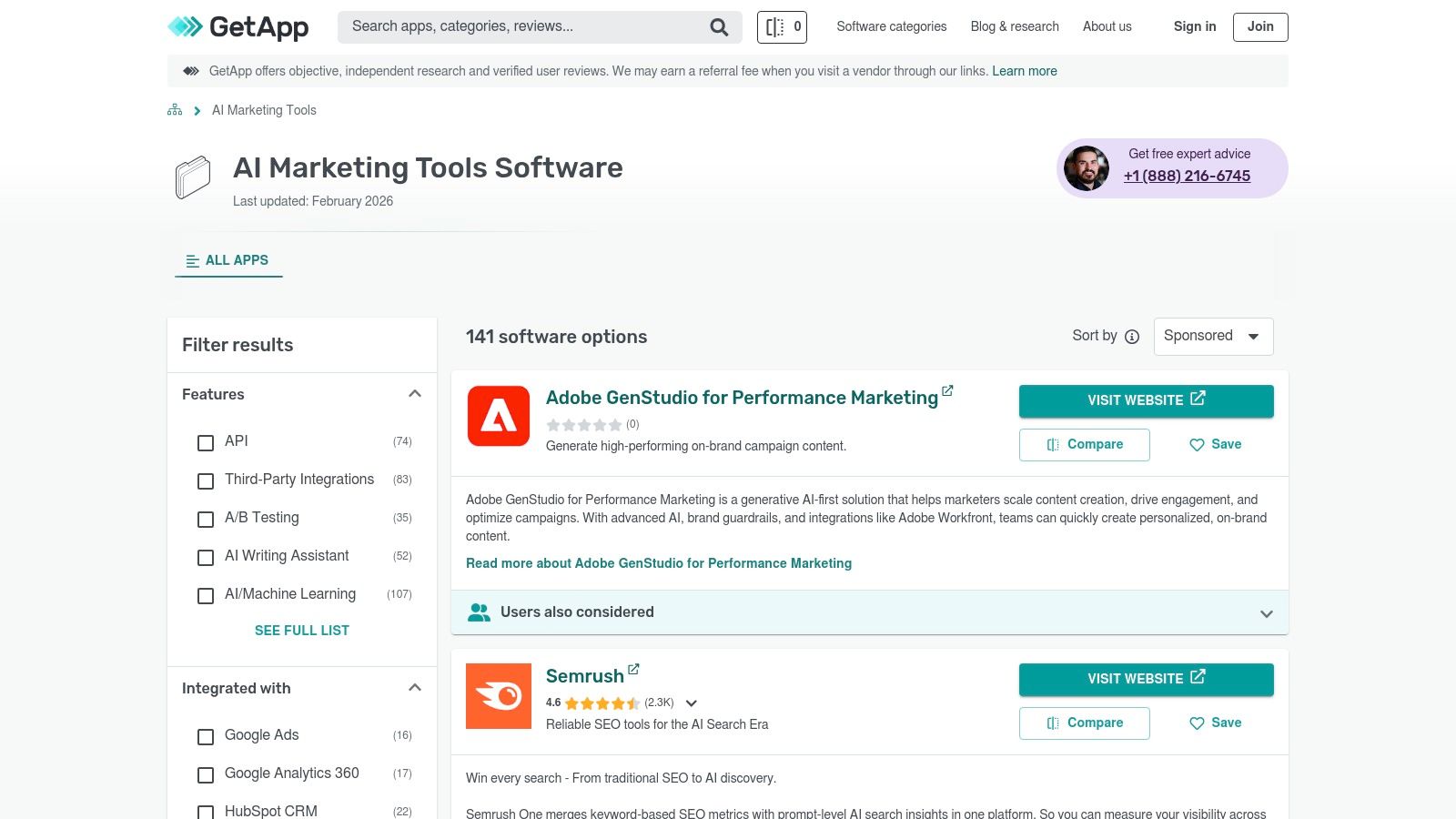
GetApp serves as an essential cross-checking platform in a marketer's evaluation process, operating as a sister site to Capterra within the Gartner Digital Markets family. It specialises in offering concise, easily digestible software reviews and unique filtering options that complement other major review sites. For those looking to validate their choices, GetApp provides another layer of user-based insight to help pinpoint the best AI tools for marketing with confidence.
Its interface allows users to filter specifically by AI capabilities like "Generative AI" or "AI/Machine Learning", a feature that is particularly useful for teams looking to adopt cutting-edge technology. GetApp also curates "Category Leaders" pages for specific marketing disciplines, such as SEO or content marketing, which quickly highlights top-performing tools based on user feedback. The visualisations showing review distribution and summarised pros and cons make it simple to get a feel for a tool's public perception at a glance.
Key Strengths & Use Cases
- Use Case: A content marketing team can use GetApp to find and evaluate AI writing assistants, using the AI-specific filters and then comparing the top three options based on the platform's aggregated pros and cons before visiting G2 for deeper review analysis.
- Valuable Second Opinion: It acts as a reliable secondary source to verify findings from Capterra or G2, ensuring a more well-rounded and less biased selection process.
- Marketing-Specific Categories: The platform's focused views on key marketing areas (SEO, multi-channel, content) help users quickly navigate to the tools most relevant to their specific role and needs.
Pros & Cons
| Pros | Cons |
|---|---|
| Good breadth of marketing-specific AI categories | Some product listings have sparse reviews |
| Useful second opinion alongside G2 and Capterra | Sponsored placements can appear – diligence required |
Website: https://www.getapp.com/all-software/ai-marketing-tools
5. Product Hunt
Product Hunt serves as the daily launchpad for the tech world, making it an essential resource for marketers eager to discover cutting-edge tools before they become mainstream. It's a community-driven platform where new products, especially AI-powered ones, are submitted, upvoted, and discussed. For marketers wanting to stay ahead of the curve, it provides a real-time feed of the best AI tools for marketing as they emerge, from innovative ad creative generators to next-gen analytics platforms.
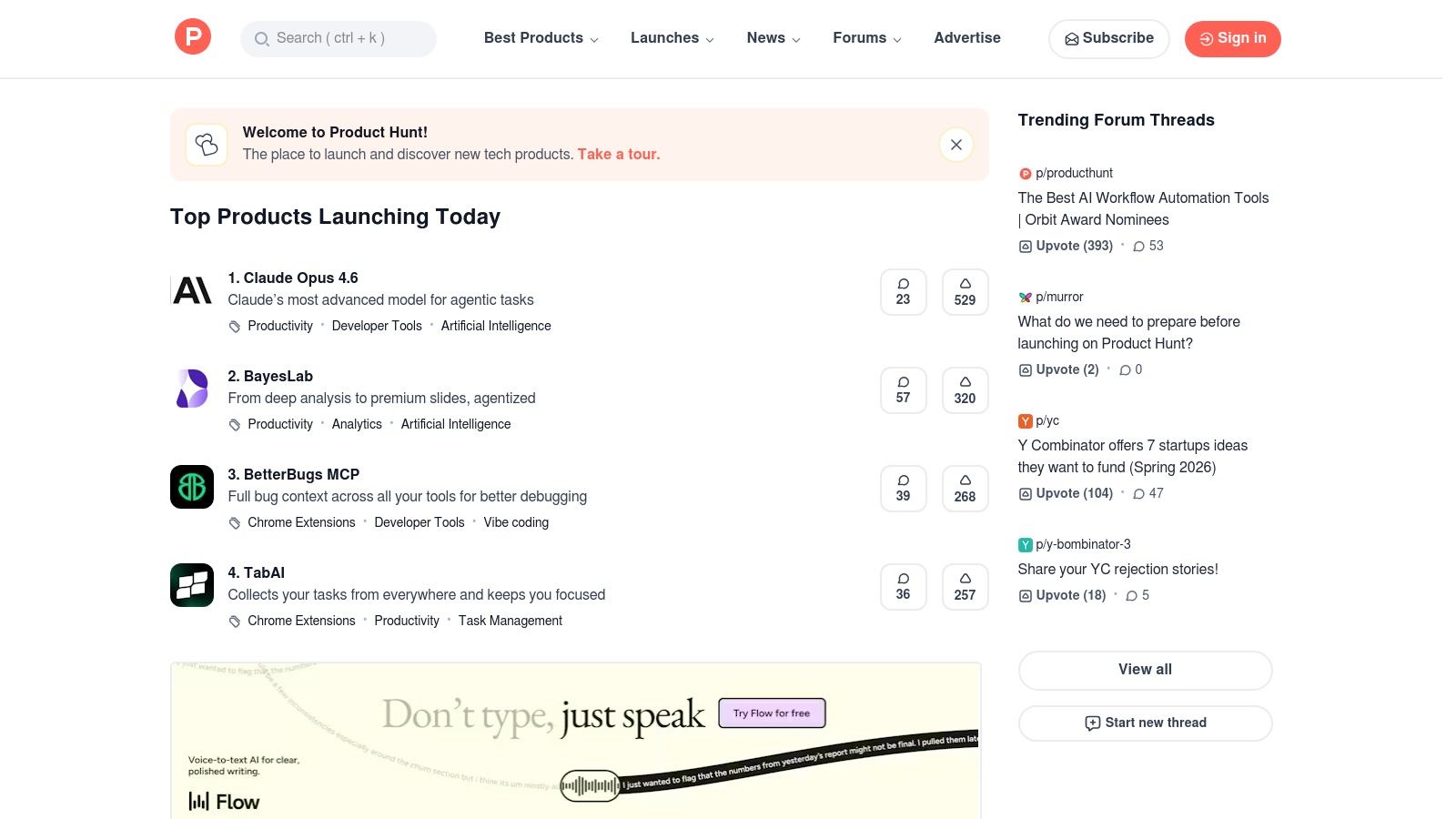
The platform's value lies in its community-first approach. The upvote system and comment sections act as an initial, unfiltered layer of social proof, allowing you to gauge early traction and user sentiment. Marketers can directly engage with the creators ("makers") to ask questions, provide feedback, and often snag exclusive launch-day promotions or extended free trials. Curated collections and daily digests further simplify discovery, bundling new AI tools by specific marketing functions like copywriting or video creation.
Key Strengths & Use Cases
- Use Case: A digital marketing strategist can browse Product Hunt daily to spot emerging AI-powered SEO or chatbot tools, evaluate early community feedback, and test promising solutions with exclusive launch deals before competitors are even aware of them.
- Early Discovery: It is arguably the fastest place to find and test nascent AI marketing technology, giving your team a significant first-mover advantage.
- Community Validation: The upvote and comment system provides immediate, albeit early, signals about a tool's potential value and user reception, helping to filter out the noise.
Pros & Cons
| Pros | Cons |
|---|---|
| Fastest place to spot new and emerging AI marketing tools | Early-stage products can change or discontinue quickly |
| Direct community feedback and occasional launch-only promotions | Less mature listings require validation before adoption |
Website: https://www.producthunt.com
6. AppSumo
AppSumo is a deal marketplace that has become a vital launchpad for budget-conscious marketing teams looking to adopt new technology. It offers lifetime and heavily discounted annual deals on a vast range of SaaS products, many of which are emerging AI tools. For marketers eager to experiment without committing to high monthly subscriptions, AppSumo provides a low-risk environment to test some of the best AI tools for marketing before they hit mainstream pricing.
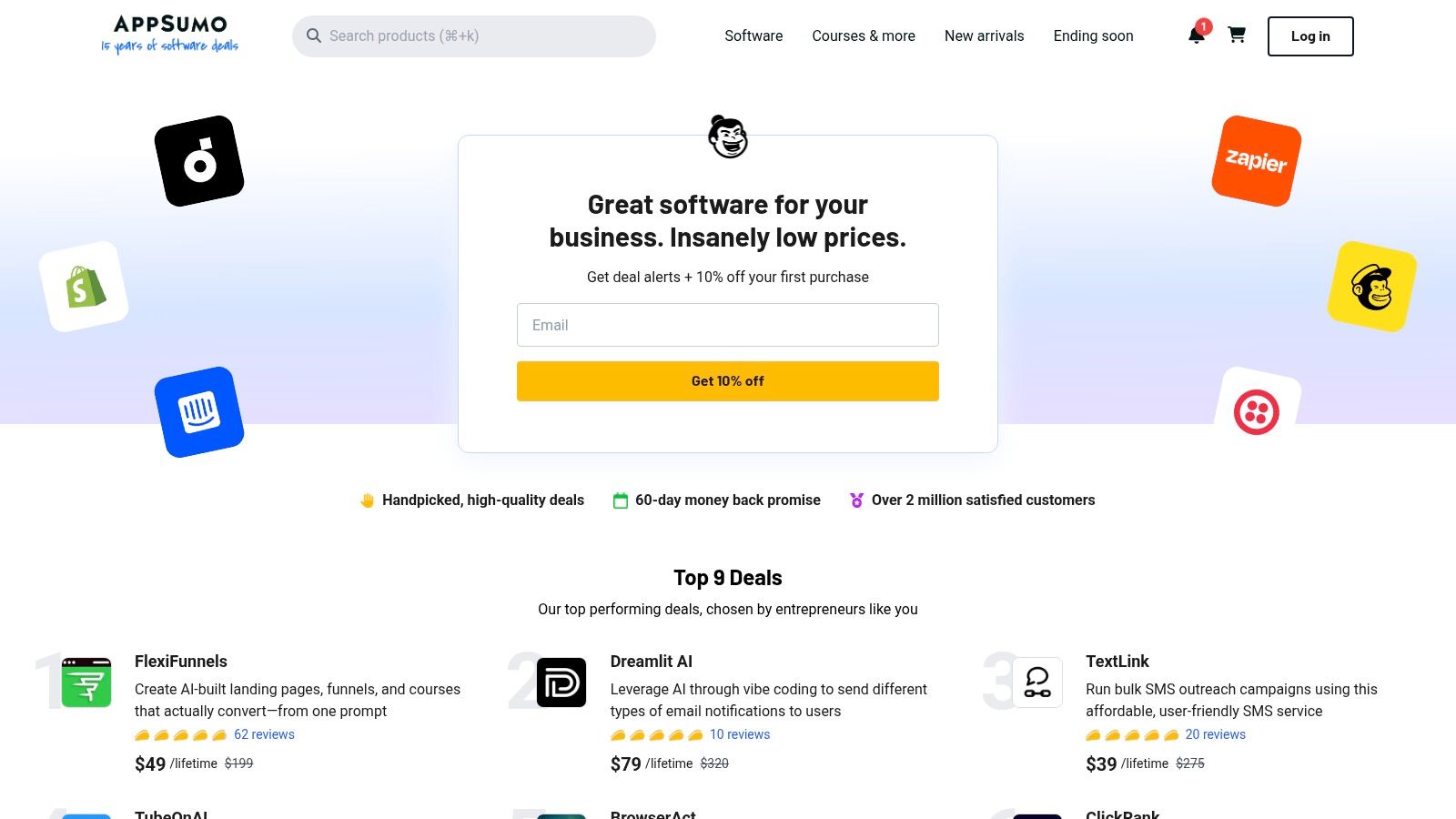
The platform is particularly valuable for discovering innovative, up-and-coming AI solutions for copywriting, creative generation, chatbots, and analytics. Each deal page is comprehensive, typically featuring tutorials, detailed feature lists, and a lively user comments section where you can gauge real-world performance. The standard 60-day money-back guarantee on most purchases removes the immediate financial risk, encouraging exploration and agility in building your marketing tech stack.
Key Strengths & Use Cases
- Use Case: A startup's marketing lead can purchase lifetime deals on three different AI content writers for less than a single month's subscription to a major competitor, allowing them to thoroughly test and select the best fit for their team's workflow at a fraction of the cost.
- Cost-Effective Experimentation: It allows teams to acquire and trial a variety of new AI tools, such as social media automators or video generators, without the burden of recurring monthly fees.
- Community Insights: The active Q&A and review sections on deal pages provide candid feedback from other users, offering valuable insights into a tool’s true capabilities and potential limitations.
Pros & Cons
| Pros | Cons |
|---|---|
| Deep discounts versus standard retail pricing | "Lifetime" deals can sometimes be sunsetted or altered |
| Centralised refund window reduces purchase risk | User experiences with support for some deals can be mixed |
Website: https://appsumo.com
7. PitchGround
PitchGround is a curated marketplace for lifetime deals (LTDs) that serves as a treasure trove for marketers seeking high-value software without recurring subscription costs. Unlike larger deal platforms, it maintains a tighter focus on marketing, growth, and productivity tools, making it an essential resource for discovering emerging best AI tools for marketing. For small businesses, startups, and solo entrepreneurs, PitchGround offers a cost-effective gateway to powerful technology that might otherwise be financially out of reach.
The platform distinguishes itself through a heavily curated selection process. Instead of overwhelming users with hundreds of offers, it hand-picks promising software, often from up-and-coming developers. This curation, combined with an active user community and transparent feedback on platforms like Trustpilot, helps marketers assess the value and long-term viability of a tool before purchasing. This is crucial for navigating the LTD space, where some tools may be in early development stages.
Key Strengths & Use Cases
- Use Case: A startup founder with a limited budget can browse PitchGround to find a lifetime deal on an AI-powered content creation suite, securing access to advanced features for a single, one-time payment instead of a hefty monthly fee.
- Niche Tool Discovery: Its marketing-centric focus allows users to uncover specialised AI tools for tasks like lead generation or social media analytics that are often missed by larger, more generalised deal websites.
- Risk-Managed Investment: By leveraging the platform’s community discussions and external reviews, marketers can make more informed decisions, reducing the risk associated with investing in newer, less-established software.
Pros & Cons
| Pros | Cons |
|---|---|
| Surfaces niche marketing tools not found on larger deal sites | Fewer deals available at any given time compared to competitors |
| Community chatter and external reviews help assess risk | Some offers are very early-stage and may lack long-term stability |
Website: https://www.pitchground.com
8. Shopify App Store
For e-commerce businesses running on Shopify, the Shopify App Store is less of a single product and more of a vital ecosystem. It serves as the primary marketplace for extensions that embed AI capabilities directly into storefront workflows. Instead of searching for standalone software, D2C and e-commerce teams can find native integrations for everything from AI-powered chatbots and product recommendation engines to SEO content assistants, making it one of the most practical places to find the best AI tools for marketing tailored for retail.
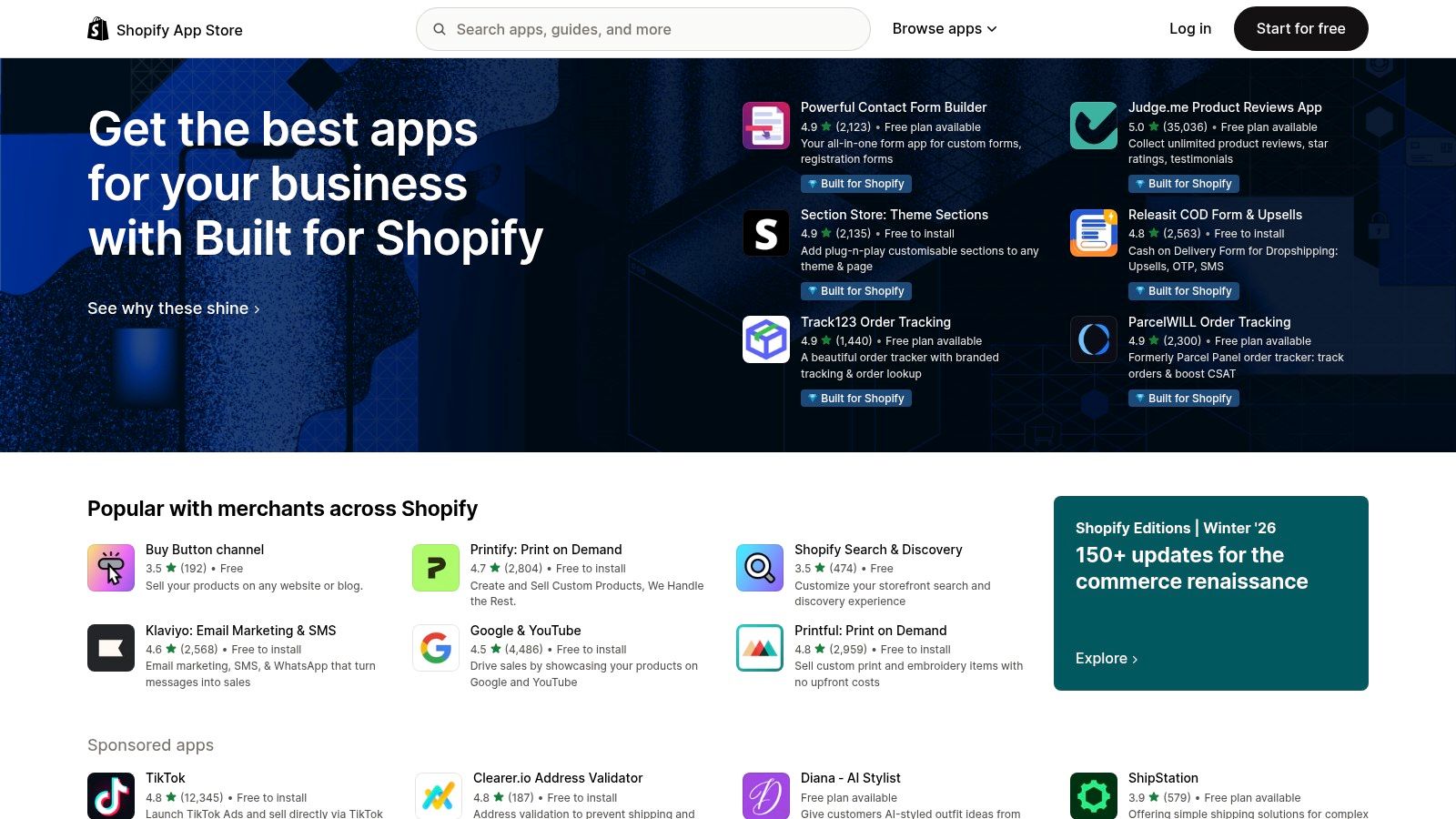
The store excels by offering plug-and-play solutions that drastically reduce the time-to-value. You can browse apps, check real user reviews, analyse pricing tiers, and often install them with a single click. Shopify also provides editorial guides and curated collections that highlight noteworthy AI applications, simplifying the discovery process for merchants. This direct integration model is perfect for teams who want to enhance their marketing without managing complex, separate platforms.
Key Strengths & Use Cases
- Use Case: An e-commerce manager can install an AI-driven personalisation app to automatically show returning visitors products based on their past browsing history, increasing conversion rates without manual effort.
- Native Integration: The core strength is the seamless connection to your Shopify store, allowing apps to pull product data, customer information, and order history to deliver highly relevant marketing.
- Diverse Ecosystem: From creating simple AI-powered video ads to deploying sophisticated customer service bots, the variety ensures a solution for nearly any e-commerce marketing challenge.
Pros & Cons
| Pros | Cons |
|---|---|
| Plug‑and‑play apps that integrate directly with Shopify stores | Some apps are new with limited track records – vet carefully |
| Abundant choice for chat, personalisation and SEO workflows | May require paid Shopify features or developer support for advanced setups |
Website: https://apps.shopify.com
9. HubSpot App Marketplace + Breeze AI
For teams already invested in the HubSpot ecosystem, the platform’s App Marketplace combined with its native Breeze AI transforms the CRM into a powerful, centralised AI marketing hub. Rather than adopting disparate tools, marketers can leverage AI that works directly with their customer data, ensuring that every output is context-aware and personalised. Breeze AI assistants and agents are embedded across HubSpot's products for tasks like content generation, prospecting, and automating customer responses.
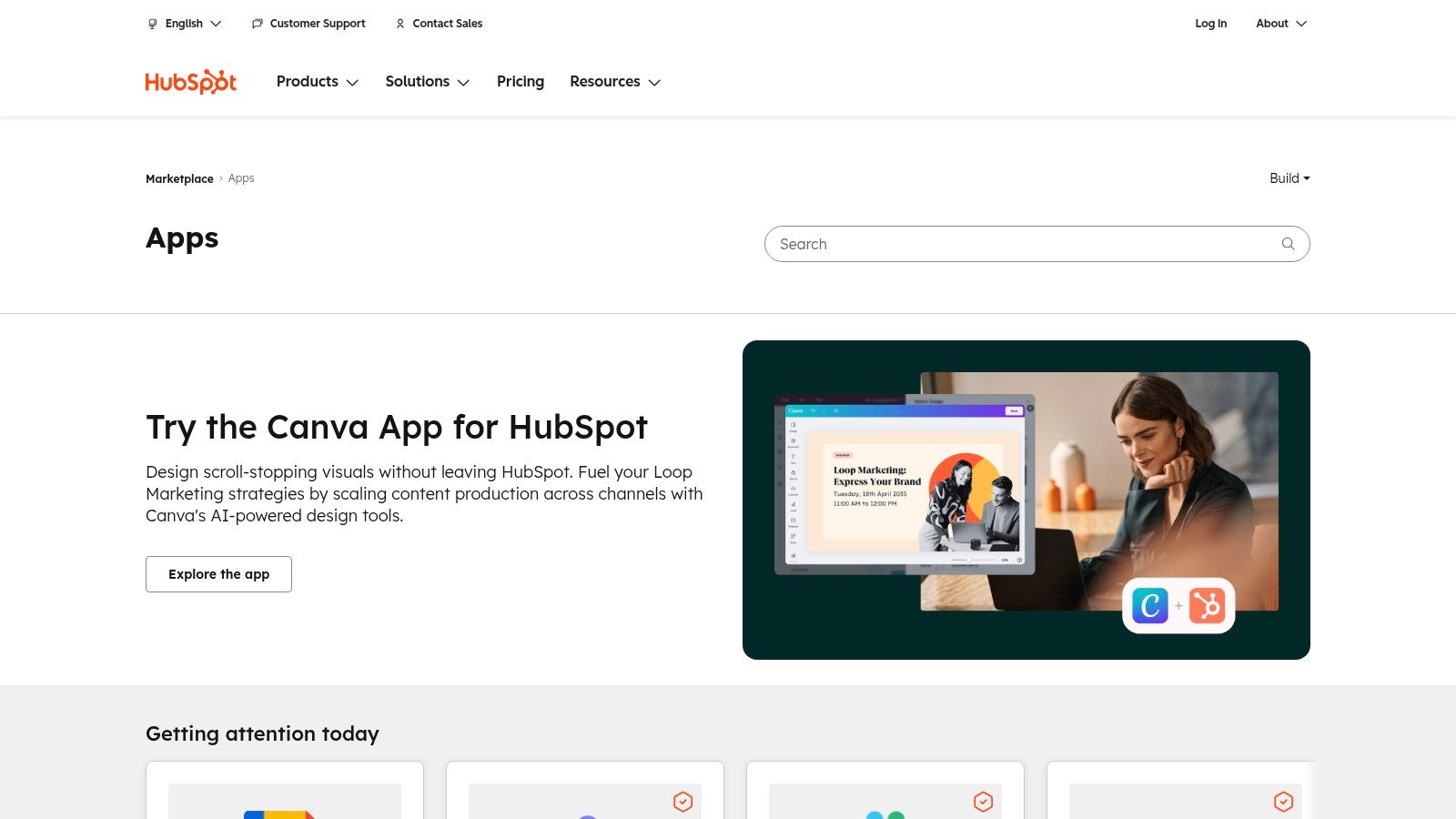
The App Marketplace complements this by offering over 1,000 vetted marketing integrations that plug directly into your existing workflows. This combination makes it one of the best AI tools for marketing for businesses aiming to operationalise AI within their core revenue operations. The true advantage lies in unifying your data with AI, which yields more relevant campaign assets, sharper segmentation, and more effective automation, all without leaving the HubSpot platform.
Key Strengths & Use Cases
- Use Case: A content marketer can use Breeze AI to generate a blog post outline based on their top-performing service pages, then use an integrated marketplace app to optimise it for SEO before publishing, all within their HubSpot portal.
- CRM-Powered AI: Breeze AI uses your CRM context to produce higher-quality, personalised outputs, from sales emails to marketing campaign copy, improving relevance and engagement.
- Seamless Integration: Marketplace apps are designed to install and work fluidly within your HubSpot stack, reducing implementation friction and consolidating your toolset.
Pros & Cons
| Pros | Cons |
|---|---|
| Unified data plus AI yields more relevant, operational outputs | Advanced Breeze/Marketplace capabilities often require paid HubSpot tiers |
| Marketplace apps integrate directly into HubSpot workflows | Costs can scale significantly at higher tiers |
Website: https://ecosystem.hubspot.com/marketplace/apps
10. Semrush App Center
For marketing teams already invested in the Semrush ecosystem, the Semrush App Center acts as a force multiplier rather than a standalone tool. It’s a curated marketplace of third-party applications that plug directly into your Semrush account, extending its capabilities into specialised areas like social media content generation, local SEO, and AI-powered creative production. This integration offers a streamlined way to access some of the best AI tools for marketing without juggling separate subscriptions and logins.
The true value lies in consolidating your marketing tech stack. Instead of sourcing and vetting disparate AI tools, you can choose from a pre-approved selection designed to complement Semrush's core SEO and competitive research features. The platform provides unified billing and seamless single sign-on, significantly reducing administrative overhead. This makes it ideal for agencies and in-house teams looking to enhance their workflows with specialised AI capabilities while maintaining operational efficiency.
Key Strengths & Use Cases
- Use Case: An SEO team using Semrush for keyword research can add an AI content generator app from the centre to immediately start creating optimised blog posts, all within the same platform and billed on one invoice.
- Reduced Tool Sprawl: It helps centralise your marketing toolkit by integrating vetted, task-specific AI apps directly into a platform your team already uses daily.
- Vetted and Exclusive Deals: Many apps are reviewed by Semrush and often come with exclusive pricing or free trial periods for Semrush subscribers, adding extra value.
Pros & Cons
| Pros | Cons |
|---|---|
| Reduces tool sprawl for teams already using Semrush | Many apps require a paid Semrush subscription to use |
| Apps are vetted and many offer free trials or Semrush pricing | App selection is most valuable when you already use Semrush |
Website: https://www.semrush.com/app-center
11. Jasper
Jasper is an enterprise-grade AI content platform designed specifically for marketing teams that require strict brand governance and repeatable workflows. Where many AI writers focus solely on raw text generation, Jasper provides an environment for creating entire multi-asset campaigns while maintaining brand consistency. This makes it one of the best AI tools for marketing for organisations that prioritise on-brand outputs, security, and collaborative content creation at scale.
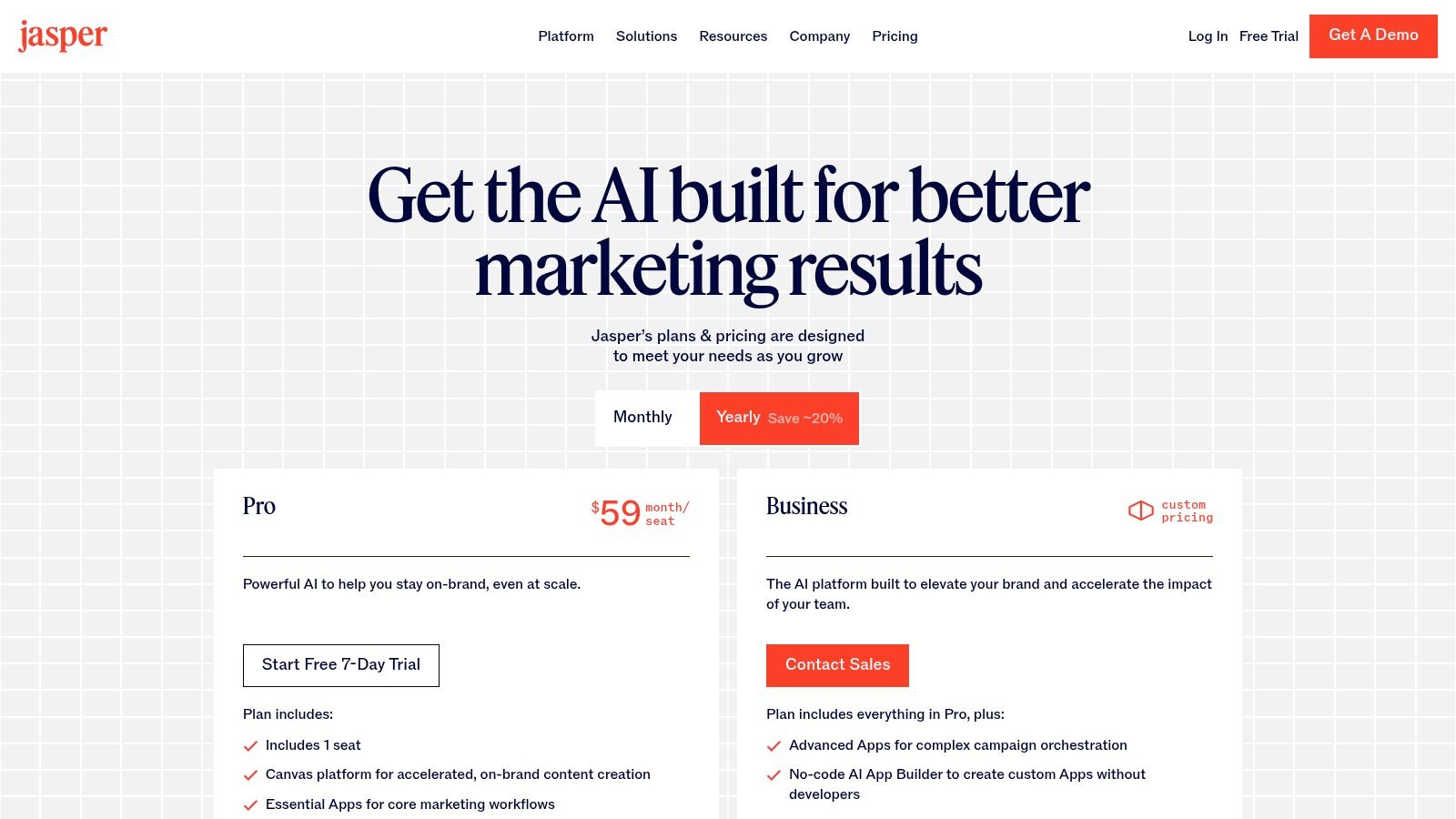
The platform distinguishes itself with features like Brand Voice and Knowledge, which allow teams to train the AI on their specific style guides, product catalogues, and company information. Its Canvas feature enables the orchestration of complex, multi-step content campaigns, moving beyond single-asset creation to a more strategic workflow. For teams looking to convert long-form content into different formats, it is a powerful asset, similar to how an AI script-to-video tool can repurpose text for new channels.
Key Strengths & Use Cases
- Use Case: A corporate marketing team can use Jasper's Brand Voice and Knowledge Base to ensure all blog posts, social media updates, and ad copy generated by different team members adhere strictly to the company's established tone and messaging guidelines.
- Campaign Orchestration: The Canvas feature is ideal for mapping out and executing comprehensive marketing campaigns, from initial brainstorming and brief creation to generating coordinated assets across email, social media, and web.
- Scalable Governance: With enterprise-level security like SSO and SOC2 compliance, along with granular user permissions, Jasper is built for large teams where control over brand assets and data is paramount.
Pros & Cons
| Pros | Cons |
|---|---|
| Designed for on-brand, repeatable marketing workflows at scale | Advanced features (agents, API, governance) require Business tier |
| Clear seat-based pricing and trial options for Pro tier | Higher tiers and enterprise features are custom-priced |
Website: https://www.jasper.ai/pricing
12. Zoho Marketing Plus
Zoho Marketing Plus offers a unified, all-in-one marketing platform designed to consolidate disparate marketing efforts into a single, cohesive ecosystem. Instead of juggling separate tools, it combines email marketing, social media management, webinar hosting, analytics, and automation under one roof, with AI features woven throughout. This integration makes it one of the best AI tools for marketing for small to medium-sized businesses, particularly in regions like India, seeking a cost-effective and streamlined stack with local billing support.
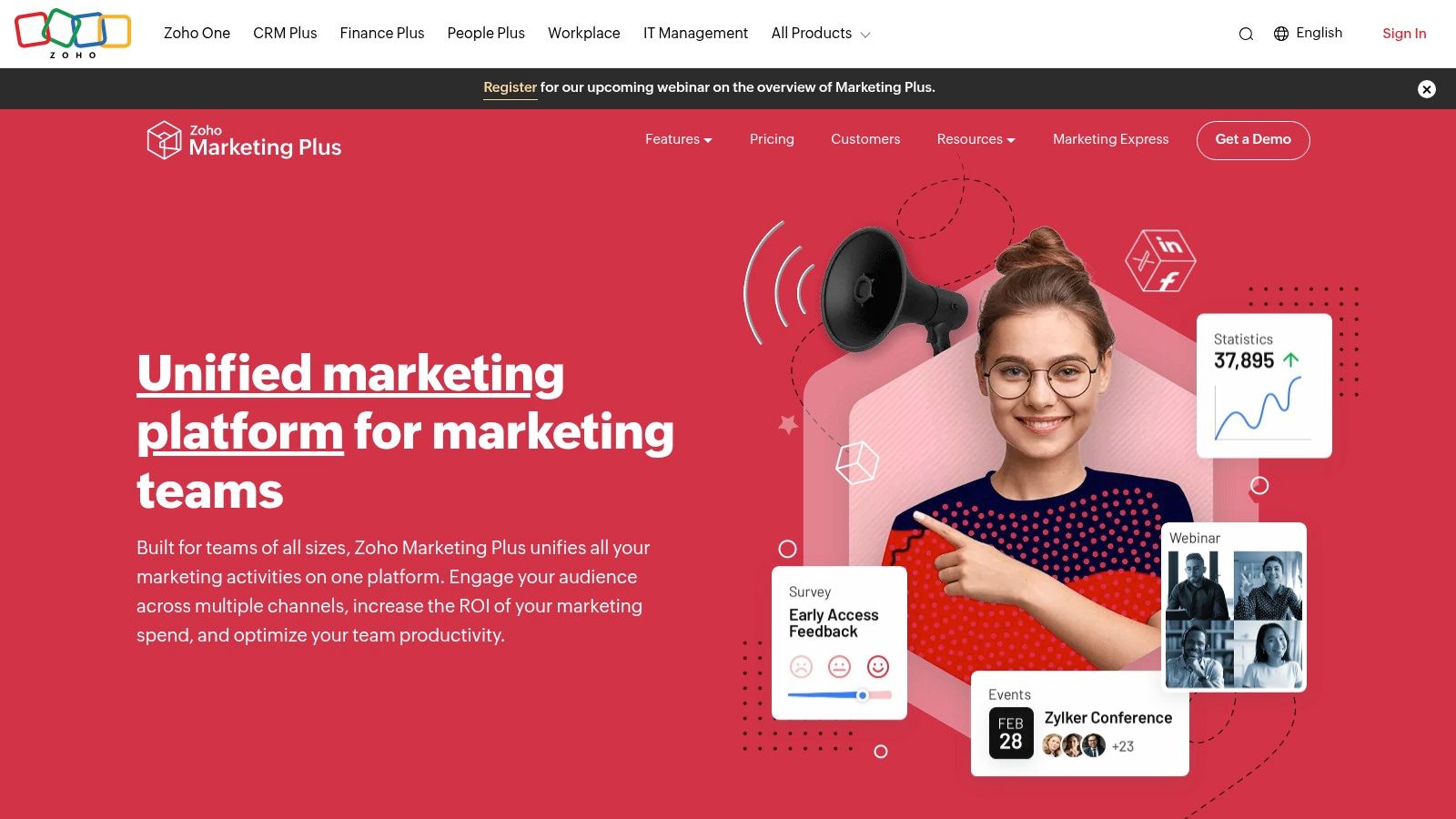
The platform centralises brand assets, campaign planning, and cross-channel execution, powered by Zia, Zoho’s AI assistant. This reduces the friction of managing multiple subscriptions and data silos. While its core offering is comprehensive, Zoho’s strength lies in its modular design. Teams can start with the essential suite and purchase add-ons for additional contacts, website visitors, or brands as they scale. This transparency allows businesses to control costs while accessing a powerful, integrated marketing engine that connects seamlessly with other Zoho apps like their popular CRM.
Key Strengths & Use Cases
- Use Case: An SMB marketing team can use Zoho Marketing Plus to plan a product launch, build the email campaign, schedule all social media posts, host a launch webinar, and track performance across every channel from a single dashboard, eliminating integration headaches.
- Consolidated Stack: It is ideal for teams looking to reduce tool-sprawl and vendor management overhead by unifying core marketing functions on one platform.
- Scalable & Modular: The transparent add-on pricing for contacts, brands, and events allows businesses to pay only for what they need, making it a flexible solution for growing teams.
Pros & Cons
| Pros | Cons |
|---|---|
| Competitive pricing and a 15-day free trial | Feature depth may require purchasing add-ons as you scale |
| Unified suite reduces integration overhead | Advanced needs may push total cost up through modular pricing |
Website: https://www.zoho.com/marketingplus
Top 12 AI Marketing Tools — Side-by-Side Comparison
| Product | Core Capabilities | UX / Quality | Value & Pricing | Target Audience | Unique Selling Points |
|---|---|---|---|---|---|
| 🏆 Glima AI | Text→image & video, multi‑ref animation, smart editors | ★★★★ — fast, intuitive, cinematic | 💰 Gated pricing — contact sales | 👥 Creators, design & marketing teams, filmmakers | ✨ All‑in‑one image+video, 100+ styles, playful effects |
| G2 | Crowdsourced reviews, side‑by‑side comparisons | ★★★★ — high review volume | 💰 Free to browse (sponsored placements) | 👥 Buyers, procurement, vendor researchers | ✨ Badges, leaderboards, deep review signals |
| Capterra | Filterable directory, buyer’s guides, pricing checklists | ★★★ — clear comparison grids | 💰 Free listings (sponsored options) | 👥 SMBs & project buyers | ✨ Buyers’ guides & feature checklists |
| GetApp | Review snippets, category filters, review distributions | ★★★ — concise reviews & filters | 💰 Free; some sponsored listings | 👥 Marketers doing cross‑checks | ✨ Marketing‑specific category views |
| Product Hunt | Daily launches, community feedback, promos | ★★★ — fast but early‑stage | 💰 Free; launch promos & trials | 👥 Makers, early adopters, product scouts | ✨ Best for discovering emerging tools quickly |
| AppSumo | Time‑limited lifetime & annual SaaS deals | ★★★ — deal pages + refund window | 💰 Deep discounts (lifetime deals) | 👥 Budget‑conscious teams & founders | ✨ Big savings for experimentation |
| PitchGround | Curated LTDs focused on marketing & productivity | ★★☆ — smaller catalog, curated picks | 💰 Curated LTD pricing | 👥 SMBs, founders seeking niche tools | ✨ Niche marketing tools & community signals |
| Shopify App Store | Native Shopify apps, storefront integrations | ★★★★ — integrated app experience | 💰 Tiered app pricing; many trials | 👥 D2C & ecommerce teams | ✨ Plug‑and‑play storefront integration |
| HubSpot App Marketplace + Breeze AI | CRM‑integrated apps + embedded AI assistants | ★★★★ — CRM context improves outputs | 💰 Paid HubSpot tiers + app costs | 👥 HubSpot users, sales & marketing ops | ✨ CRM‑backed personalization & agents |
| Semrush App Center | SEO/content/social add‑ons inside Semrush | ★★★★ — vetted, seamless SSO | 💰 Per‑app pricing; needs Semrush | 👥 SEO & competitive research teams | ✨ Unified billing, Semrush‑exclusive apps |
| Jasper | Brand governance, campaign workflows, AI apps | ★★★★ — collaboration & governance | 💰 Seat‑based tiers (Pro, Business) | 👥 Content teams, enterprises | ✨ Brand controls, AI agents & workflow tools |
| Zoho Marketing Plus | Unified marketing suite with AI assistance | ★★★ — consolidated but modular | 💰 Competitive, transparent add‑ons | 👥 SMBs (strong value in APAC) | ✨ All‑in‑one stack with modular pricing |
Choosing Your AI Co-Pilot: Final Thoughts on Building a Smarter Marketing Stack
We've journeyed through a comprehensive landscape of platforms and specialised applications, each offering a unique way to inject artificial intelligence into your marketing efforts. From the vast app marketplaces of HubSpot and Semrush to dedicated content powerhouses like Jasper and creative suites like Glima AI, the common thread is clear: AI is no longer a futuristic concept but a practical, results-driven co-pilot for modern marketers. The integration of AI has fundamentally changed the game, moving beyond simple automation to become a strategic partner in creativity, analysis, and personalisation.
The sheer volume of options can feel overwhelming, but this diversity is your greatest advantage. It signifies a mature market where you can find a solution meticulously tailored to your specific challenges, whether you're a solo content creator or part of a large enterprise marketing team. The key takeaway is that there is no single "best" AI tool for everyone; the ideal choice is deeply personal to your organisation's goals, existing technology stack, and operational bottlenecks.
A Practical Framework for Selection
Before committing to a subscription, it's crucial to adopt a structured approach to your decision-making process. Avoid the temptation of chasing the newest, trendiest tool. Instead, ground your selection in a clear understanding of your needs.
Here’s a simple framework to guide your next steps:
Identify Your Primary Pain Point: Pinpoint the single biggest hurdle your team faces. Is it the time-consuming process of creating high-quality visual assets for social media? The struggle to write compelling, SEO-optimised copy at scale? Or the challenge of sifting through campaign data to find actionable insights? Your most significant bottleneck should be your first priority.
Audit Your Existing Workflow: How does your team currently operate? Map out your content creation, campaign management, and reporting processes. A new tool should seamlessly integrate into this workflow, not disrupt it. Look for tools with robust integrations, like those found in the HubSpot App Marketplace, to ensure a smooth transition.
Define Your Success Metrics: How will you measure the tool's impact? Establish clear Key Performance Indicators (KPIs) beforehand. This could be a reduction in content production time, an increase in lead generation, a higher click-through rate on ads, or improved engagement metrics on social media.
Leverage Free Trials and Demos: Never purchase a tool without test-driving it first. Almost every platform we've discussed, from Zoho Marketing Plus to Glima AI, offers a free trial or a product demo. Use this period to involve your team, test core features with real-world tasks, and evaluate the user interface's intuitiveness.
Strategic Implementation and Future-Proofing
Once you've selected a tool, implementation is the next critical phase. Remember, these platforms are powerful, but they aren't magic. Success requires a strategic rollout, including proper team training and setting realistic expectations. Start small by integrating the tool into a single project or campaign. This allows your team to build confidence and develop best practices before a full-scale deployment.
Furthermore, building a truly intelligent marketing stack involves looking at the complete customer journey. This means connecting your content and ad platforms with other crucial systems. To truly build a smarter marketing stack, consider integrating comprehensive platforms, including the best influencer marketing tools, that leverage AI for efficient campaign management and analysis. This holistic view ensures that every part of your strategy is data-informed and optimised.
The world of AI is evolving at a breathtaking pace. The best AI tools for marketing today will be even more sophisticated tomorrow. By choosing platforms committed to continuous innovation and focusing on solving your core business challenges, you are not just adopting a new piece of software. You are building a more agile, creative, and data-driven marketing engine poised for future success.
Ready to revolutionise your team's visual content creation and eliminate creative bottlenecks? Glima AI provides a unified platform for generating, editing, and managing all your marketing assets with the power of AI. Start your free trial today and see how effortlessly you can produce studio-quality visuals that capture attention and drive results.